
Views: 0 Author: Site Editor Publish Time: 2026-03-23 Origin: Site


When drivers talk about vehicle control, they often focus on the steering wheel, tire alignment, or overall handling feel. But behind every smooth turn is a group of steering components working together with precision. Understanding steering parts names and functions is important not only for mechanics and parts buyers, but also for distributors, workshop owners, and everyday vehicle users who want to make informed repair decisions. Parts such as tie rod ends, rack ends, steering racks, and steering pumps may seem technical at first, yet each one plays a clear role in turning driver input into safe, stable wheel movement.
A steering system is not just about making a car turn left or right. It directly affects:
· vehicle stability
· driver confidence
· tire wear
· suspension response
· road safety
When one component begins to wear out, the symptoms often spread through the system. A worn tie rod end can create loose steering. A damaged steering rack can make the wheel feel heavy or inconsistent. A failing pump may cause noise and poor hydraulic pressure. That is why buyers who understand the basics are usually better at selecting the right part and identifying related issues before they become expensive repairs.
To make the system easier to understand, here is a simple overview of the key steering parts discussed in this article.
Steering Part | Main Function | Common Symptoms of Failure | Typical Importance |
Tie Rod End | Connects steering linkage to the steering knuckle and helps move the wheel | Loose steering, uneven tire wear, knocking noise | Critical for steering accuracy |
Rack End | Links the inner steering rack to the outer tie rod end | Play in steering, vibration, unstable handling | Important for steering transfer |
Steering Rack | Converts steering wheel movement into side-to-side motion | Hard steering, leakage, poor return, uneven response | Core steering control unit |
Steering Pump | Supplies hydraulic pressure in hydraulic steering systems | Whining noise, stiff steering, fluid leak | Essential for steering assist |
This table gives a basic framework, but each part deserves closer attention.
Tie rod ends are among the most recognized steering parts because they are directly involved in wheel direction. In simple terms, the tie rod end connects the steering linkage to the steering knuckle, allowing steering force to move the wheels while still permitting suspension travel.
A good tie rod end must do two things at the same time:
1. transmit steering motion accurately
2. allow flexible movement as the suspension travels over bumps
Because the tie rod end is constantly exposed to road shock, dust, water, and repeated turning forces, it is a wear item in many vehicles. Once the ball joint inside becomes loose, the driver may notice wandering, poor alignment retention, or a knocking sound during turns.
· steering feels loose or vague
· front tires wear unevenly
· clunking noise from the front end
· vehicle drifts even after alignment
· steering wheel response becomes delayed
In parts purchasing, tie rod ends are often underestimated because they are relatively small. However, their effect on handling precision is significant.
Rack ends, sometimes called inner tie rods in many markets, sit between the steering rack and the outer tie rod ends. Their job is to transfer movement from the rack assembly outward to the steering knuckle through the tie rod structure.
This makes the rack end a critical connecting point rather than a simple accessory part. If the rack end develops wear, steering looseness can appear even when the steering rack itself is still serviceable.
A rack end must maintain strength under repeated push-pull movement. It also has to absorb vibration while preserving steering accuracy. Poor-quality rack ends can create:
· excessive steering play
· front-end rattling
· unstable road feel
· shorter service life for related components
In practical repair situations, technicians often inspect rack ends and outer tie rod ends together because both can affect alignment and steering response. Replacing only one worn component while ignoring the other can leave the steering system partially corrected rather than fully restored.
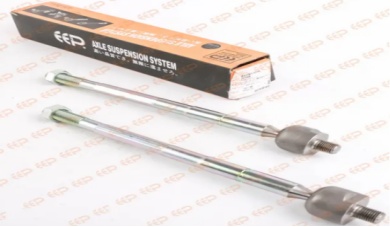
If tie rod ends and rack ends are the linking points, the steering rack is the heart of the steering assembly. Its main function is to convert the rotational motion of the steering wheel into the linear movement needed to turn the wheels.
In rack-and-pinion steering systems, when the driver turns the wheel:
· the steering shaft turns the pinion gear
· the pinion moves the rack left or right
· the rack pushes or pulls the rack ends
· the tie rod ends direct the wheels accordingly
This design is widely used because it offers compact packaging, responsive control, and reliable steering feel.
There are two common categories:
These rely entirely on driver force. They are simpler in construction but require more effort.
These work with hydraulic or electric assistance, reducing steering effort and improving comfort, especially at low speed.
A worn or damaged steering rack can show up in several ways:
· fluid leakage around seals
· stiff or inconsistent steering
· steering wheel not returning smoothly
· knocking or internal play
· uneven turning effort left to right
Because the steering rack is a major assembly, correct matching is essential. Vehicle model, year, steering side, mounting points, and hydraulic or electric configuration all need to match properly.
In hydraulic power steering systems, the steering pump is responsible for generating the hydraulic pressure that helps the driver turn the wheels more easily. Without adequate pump pressure, steering effort increases, especially during parking, low-speed turns, or heavy-load conditions.
A steering pump does not steer the vehicle by itself. Instead, it assists the steering rack by supplying pressurized fluid. This fluid reduces the physical force needed at the steering wheel.
· whining or groaning sound when turning
· heavy steering at low speed
· foamy or leaking power steering fluid
· delayed steering assist
· vibration in the steering wheel
Not every hard-steering problem is caused by the pump. Sometimes the issue may come from low fluid, a blocked line, internal rack damage, or belt problems. Still, the pump remains one of the most important components in hydraulic steering systems, and its condition should never be overlooked.
One of the best ways to understand steering parts names and functions is to see them as a chain rather than separate pieces.
Here is the sequence:
Steering wheel input → steering shaft → steering rack → rack ends → tie rod ends → wheel direction
If the vehicle uses hydraulic assistance, the steering pump supports the rack by providing pressure. Each part depends on the next. That is why a steering complaint is often the result of combined wear rather than a single failed part.
For example:
· A weak pump can make the steering feel heavy.
· A worn rack can make the movement inconsistent.
· Loose rack ends can reduce steering precision.
· Damaged tie rod ends can affect wheel angle and alignment.
From a parts supply perspective, understanding this relationship is valuable because it helps buyers evaluate whether they need a single replacement part or a more complete steering repair solution.
Understanding tie rod ends, rack ends, steering racks, and pumps makes it easier to see the steering system as a complete working structure rather than a list of unrelated product names. When buyers, mechanics, and vehicle owners understand these steering parts names and functions clearly, they are better prepared to identify symptoms, choose suitable replacements, and maintain steering performance with fewer mistakes. At Guangzhou Eep Auto Parts Co., Ltd., we believe that good parts decisions start with good technical understanding. That is why we focus not only on supplying steering components, but also on helping customers better understand what they are buying, how each part works, and what matters most in long-term performance. If you are comparing steering parts for your market, workshop, or distribution business, learning more from an experienced supplier can be a practical next step.
A rack end is the inner connection attached to the steering rack, while a tie rod end is the outer connection linked to the steering knuckle. They work together to transfer steering movement to the wheels.
Yes. If a steering pump cannot provide stable hydraulic pressure, it can increase stress on the steering rack and reduce overall steering performance, especially in hydraulic systems.
Tie rod ends should be inspected during routine suspension and alignment checks, especially if the vehicle shows loose steering, uneven tire wear, or front-end noise.
Not always, but in many cases it is recommended. Replacing related parts in pairs can help maintain balanced steering response and reduce the chance of uneven wear.