
Views: 60 Author: Site Editor Publish Time: 2026-01-06 Origin: Site


One of the most persistent myths in automotive repair is the idea that every vehicle sits on a standard set of four control arms. Many drivers assume a uniform suspension layout exists across all makes and models, but reality is far more complex. Suspension architecture varies wildly between a compact economy car and a heavy-duty pickup truck. This variation means the actual component count can range from a simple pair to a complex web of over a dozen links. Misunderstanding this architecture often leads to costly ordering errors.
The stakes of getting this count wrong are higher than simple inconvenience. If you misdiagnose a "clunking" noise or order a single replacement part when a mated pair is required, you risk doubling your labor costs. A vehicle on a lift costs money every hour it sits idle waiting for the correct components. Furthermore, failing to replace mated components in complex multi-link systems can lead to uneven tire wear and erratic handling.
This guide moves beyond simple counting to explore the engineering behind the numbers. We will break down the differences between MacPherson struts and multi-link systems, clarify confusing terminology like "rearward" versus "forward" arms, and help you distinguish specific requirements for different global manufacturers. You will learn how to identify your specific suspension setup and make purchasing decisions that minimize long-term repair costs.
No Universal Standard: Most economy cars have 2 (front lower only), while performance/luxury vehicles can have 8–10+ (multi-link systems).
Architecture Dictates Quantity: MacPherson struts minimize arm count; Double Wishbone and Multi-link systems maximize it for handling precision.
Terminology Trap: Beware of "Front Lower Rearward" vs. "Front Lower Forward" arms—a common source of ordering errors.
The "Assembly" Rule: Replacing the full control arm assembly is usually more cost-effective than paying labor to press in new bushings.
Replacement Logic: Always replace in axle pairs to maintain alignment geometry and braking stability.
To determine exactly how many arms are under your chassis, you must first identify the suspension architecture. Engineers design these systems based on the vehicle's intended purpose: economy, towing capacity, or cornering precision. Each goal dictates a specific number of connection points between the frame and the wheels.
The most common setup on modern passenger vehicles is the MacPherson strut. Manufacturers favor this design for its simplicity and space-saving properties. In this configuration, the shock absorber and spring assembly (the strut) serves as the upper pivot point for the steering knuckle. Because the strut handles the upper load and geometry, the vehicle does not require an upper control arm.
Consequently, most vehicles with MacPherson struts feature a total of two front control arms—one lower arm for the driver’s side and one for the passenger’s side. You will typically find this arrangement on daily drivers like the Toyota Corolla, older Honda Civics, and most compact crossovers. It offers a balance of comfort and low maintenance costs, as there are fewer bushings and ball joints to wear out.
When handling dynamics or load-bearing strength take priority, engineers utilize a Double Wishbone suspension. This system uses two arms per wheel: an upper arm and a lower arm. They work together to keep the tire perpendicular to the road surface during hard cornering or heavy suspension compression.
For a vehicle equipped with this system, you are looking at a minimum of four front control arms. The "A-arm" shape of these components provides superior structural rigidity. This is why you almost always see this setup on pickup trucks like the Ford F-150 or Toyota Tacoma, as well as agile sports cars like the Mazda Miata. If you are shopping for replacements, remember that you likely need to inspect both the upper and lower assemblies for play.
The complexity increases significantly with modern luxury sedans and high-performance European models. To achieve a "magic carpet" ride that isolates bumps while maintaining razor-sharp steering, engineers split the traditional A-arm into individual links. Instead of a single triangular arm, the system might use two or three separate straight arms to define the wheel's position.
In these sophisticated setups, a single corner of the car can have three to five independent links. This means a full vehicle set could easily exceed 8 to 12 distinct arms. While this design offers unparalleled ride quality, it drastically increases the potential points of failure. When sourcing control arms for these vehicles, it is critical to identify exactly which link in the chain has failed.
| Suspension Type | Typical Front Arm Count | Primary Benefit | Common Applications |
|---|---|---|---|
| MacPherson Strut | 2 (1 Lower per side) | Cost & Space Efficiency | Economy sedans, Compact SUVs |
| Double Wishbone | 4 (1 Upper + 1 Lower per side) | Camber Control & Strength | Trucks, Sports Cars |
| Multi-Link | 8+ (Multiple links per side) | Ride Comfort & Precision | Luxury Sedans (BMW, Mercedes), Audi |
It is important to note that the rear of the vehicle often follows different rules. Many economy cars use a "Torsion Beam" rear suspension, which is a semi-independent solid beam that may not use traditional control arms at all. Others rely on "Trailing Arms," which run parallel to the length of the car. While these technically function as control arms, they are often categorized differently in parts catalogs. Always verify if the noise or alignment issue is coming from a transverse arm or a longitudinal trailing arm.
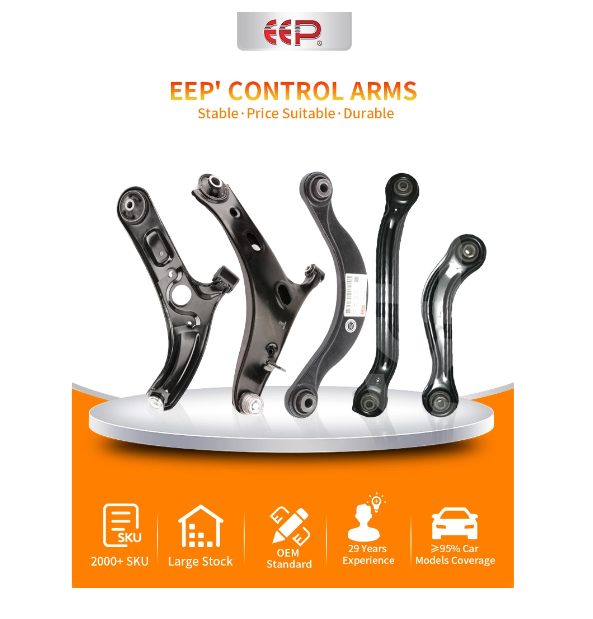
Knowing the theoretical types is useful, but identifying what is actually under your car requires a visual inspection. Parts catalogs are notorious for listing every possible option for a model year, leaving the buyer to guess which version they own.
The quickest way to confirm your architecture is the "Look Up" test. Turn your steering wheel fully to one side and shine a light into the wheel well. Look at the top of the wheel knuckle (the part the wheel bolts to). If you see a shock absorber going straight up into the fender tower with no metal arm attaching to the top of the knuckle, you have a MacPherson strut system (1 arm per wheel). However, if you see a metal wishbone or link grabbing the top of the knuckle, you have a Double Wishbone or Multi-link setup (2+ arms per wheel).
A major source of frustration for mechanics and DIYers arises when a car has a "split lower arm" design. In this scenario, the bottom of the wheel knuckle is held by two separate arms rather than one A-shaped piece. Parts diagrams label these as "Front Lower Forward" and "Front Lower Rearward."
This terminology is often misinterpreted. "Front Lower Rearward" does not refer to the rear suspension of the car. It refers to the specific arm on the front suspension that is positioned closer to the cabin (rearward), while the "Forward" arm is closer to the front bumper. Confusing these two will result in receiving a part that looks somewhat correct but will not bolt on due to different lengths and bushing angles.
Global manufacturing differences also affect terminology. When searching for suspension arms for Japanese cars, you might encounter terms like "Lateral Links" or "Tension Rods" instead of standard control arms. Subaru and Nissan, for example, often use specific lateral links in the rear multi-link setups that are prone to bending. Conversely, European manufacturers like BMW often refer to the forward lower arm as a "Thrust Arm" or "Tension Strut." Understanding these naming conventions ensures you filter your search results correctly.
Once you know how many arms you need, you must evaluate the material quality. The aftermarket offers various grades of components, and the cheapest option is rarely the best long-term investment. Manufacturers generally use three primary materials.
Stamped Steel (The Standard): This is the most common material for economy vehicles. It is cost-effective and engineered to flex slightly under load. This flexibility prevents the arm from snapping under minor impacts, such as hitting a pothole. However, stamped steel consists of two sheets welded together, creating seams where moisture can collect. In the "Rust Belt," internal corrosion often weakens these arms from the inside out.
Cast Iron (The Heavy Duty): Found on trucks and older SUVs, cast iron is extremely durable and resists bending better than steel. It is less likely to rust through, but it is heavy. This added weight increases the "unsprung mass" of the suspension, which can negatively impact fuel economy and make the handling feel sluggish.
Forged/Cast Aluminum (The Premium Choice): Aluminum arms are the gold standard for modern performance. They are lightweight, which helps the tire maintain better contact with the road, and they are naturally resistant to corrosion. The downside is the cost and the failure mode. Aluminum is more brittle than steel; in a severe impact, it tends to crack or snap rather than bend. While aftermarket aluminum upgrades exist, they are generally only worth the 2x price premium if you are driving a performance application where handling is paramount.
When a control arm fails, it is rarely the metal arm itself that breaks. Usually, the rubber bushing cracks, or the ball joint develops play. This leads to the "Technician's Dilemma": should you replace just the small failed components, or swap out the entire metal assembly?
On the surface, buying a $20 bushing seems cheaper than an $80 control arm. However, this calculation ignores the complexity of labor. Removing an old bushing requires a hydraulic press and specialized dies. If you are paying a shop, the labor time to press out a rusted bushing and press in a new one often exceeds the cost of the new arm.
Bushing Only Option: Part Cost ($20) + Press Work Labor ($150) = High Total Cost. Risk of improper seating or damaging the arm during pressing.
Full Assembly Option: Part Cost ($80) + Bolt-on Labor ($80) = Lower Total Cost. You get a brand new metal arm, a new ball joint, and fresh bushings.
The pre-assembled arm wins on almost every metric. It comes with the ball joint torqued to factory specifications, eliminating safety risks. It also solves the problem of "rust welding," where the old bushing shell fuses to the arm. Unless you own a hydraulic press and have hours of free time, purchasing the full assembly is the smarter financial move. It renews the metal fatigue life of the component and ensures a faster, cleaner repair.
Even with the right part number in hand, installation protocols determine the longevity of the repair. Ignoring these rules can ruin your new parts in under 5,000 miles.
Suspension components on the left and right sides of the vehicle endure the same mileage, road conditions, and environmental stress. If the driver-side control arm bushing has collapsed, the passenger side is likely not far behind. Mechanics insist on changing them in pairs to ensure predictable braking and steering response. Mixing a stiff new bushing on the left with a soft, worn bushing on the right can cause the vehicle to pull to one side under hard braking.
Replacing a control arm alters the physical geometry of the suspension. A wheel alignment is non-negotiable after this repair. Driving without an alignment will destroy your tires rapidly. Furthermore, modern vehicles equipped with Electronic Stability Control (ESC) or Lane Keep Assist often require a Steering Angle Sensor (SAS) reset. If the car thinks it is driving straight but the steering wheel is crooked due to new parts, the safety systems may engage inadvertently.
Finally, always double-check the "Position" filters on parts websites. Ensure you aren't buying an "Upper" arm when you need a "Lower," or a "Left" when you need a "Right." Additionally, pay attention to ball joint taper sizes. Truck manufacturers sometimes change the size of the ball joint taper mid-production year. If your new part wobbles in the knuckle hole or won't tighten down, you likely have the wrong taper size.
The question "how many control arms does a car have" is not just trivia—it is the blueprint for your repair budget. Whether your vehicle relies on a simple pair of MacPherson struts or a complex web of multi-link aluminum arms, understanding the architecture is the first step toward a successful repair. By verifying the specific material needs and opting for full assembly replacements, you minimize the Total Cost of Ownership and avoid repetitive labor charges.
Before you click "buy," take a moment to perform a visual inspection. Check your owner's manual or look behind the wheel to confirm if you need a specific kit or a single arm. Replacing suspension components is an investment in safety; ensure you have the correct count and the right strategy to keep your vehicle on the road.
A: No. Driving with a bent arm is dangerous. It alters suspension geometry, causing severe steering instability and rapid, uneven tire wear. In extreme cases, the stress can snap the ball joint, causing the wheel to separate from the vehicle entirely.
A: Costs vary widely by vehicle type. For an economy car, a DIY replacement might cost around $100 for parts. For a luxury vehicle requiring professional labor and alignment, a shop may charge between $500 and $1200 per axle.
A: Yes, they are the primary components that define the camber (vertical tilt) and caster (steering axis tilt) angles. Any replacement or wear in these arms directly changes where the wheel sits relative to the road.
A: The terms are often used interchangeably. However, "control arm" typically implies a component that actively manages suspension geometry (like an A-arm), while "suspension arm" can be a broader term covering links, trailing arms, and rods.
A: Control arms typically last between 90,000 and 100,000 miles. However, the lifespan depends heavily on road conditions. The metal arm rarely fails; it is usually the rubber bushings or ball joints that wear out first.